
Tariffs, Inflation, Jobs and CRE: Q&A with Green Street’s Frederic Blondeau

The Canadian economy began an upward trajectory in the aftermath of the pandemic. However, various issues have generated a slowdown, which is impacting several industries.
Connect CRE Canada recently asked Frederic Blondeau, Green Street’s Head of Canadian Research, for some clarity on how the economy and tariff issues are impacting the commercial real estate sector.

Connect CRE Canada: Let’s start with the big picture. How is the economy behaving, especially given tariffs and a new government?
Frederic Blondeau: If you had asked this about a year ago, I would have said the macro conditions in Canada, the economic performance, were relatively okay. Even into the first quarter of this year, GDP was solid, job creation was about what was expected and relatively solid across the board.
But inflationary pressures are still a question mark. (Prime Minister Mark) Carney was quite clear that he wants to continue supporting the overall economy, in the context of the Bank of Canada’s efforts to get to the target inflation rate of 1% to 3%.
The good news is that the central bank’s efforts in 2024 and the first quarter of 2025 have been effective. But there are still concerns about inflation.
Also, while the labour market seems to be expanding, it has been supported by the public sector. Unfortunately, the private sector is experiencing job losses, and it’s likely to stay in negative territory for the next four quarters. Added to this issue are immigration curtailments, which impact labor availability and costs. These factors have dampened economic growth.
Connect CRE Canada: What impact do the U.S. tariff actions have on all of this?
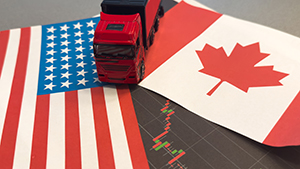
Frederic Blondeau: It’s pretty large. The U.S. is our biggest trading partner right now; 75% of our exports go there, which is 20% of our GDP. China is our second greatest trading partner—but only 5% of our exports go there. The tariff issue means we’re revising our economic metrics like GDP and job growth downward. All of that will have a meaningful impact on the property sector.
Connect Canada: Well, that was my next question. How is the current situation impacting the overall real estate sector?
Frederic Blondeau: It’s precarious, but not only because of tariffs or inflation, though those aren’t helping. Going back a couple of years, the apartment sector was funded by the government to address the housing shortage, but then demand fell, as a result of affordability issues and the increase in joblessness. So we’re trying to absorb the significant supply that has come online over the past two years.
Industrial has also been impacted by oversupply. Tenants are pausing leasing decisions because of tariff uncertainty, which is impacting investments and jobs; everything is in a holding pattern. The office sector continues bumping along the bottom; again, negative job growth is the problem here. One bright spot is retail. The grocery and essential needs areas are doing well. But consumers are watching their wallets so that outlook could change.
Connect CRE Canada: Speaking of retail, are you concerned about Hudson’s Bay closing?

Frederic Blondeau: What we’re concerned about is overall discretionary spending in the country, especially in the context of the job losses I discussed and the uncertainty that’s impacting decision-making processes across businesses. Will there be a spillover or a domino effect from the Hudson’s Bay closure? We’re not seeing that right now, but there is the concern about strip retail. Still, food centers and those types of properties are attracting a lot of capital and are probably one of the most sought-after asset classes across the country.
Connect CRE Canada: So, is retail a favoured asset of Green Street?
Frederic Blondeau: Actually, we like industrial, followed by retail, apartment and office.
Connect CRE Canada: That’s surprising. Didn’t you say industrial is in a holding pattern due to oversupply and tariff threats?
Frederic Blondeau: I did. But the virtual weighted-average lease terms, compared to other real estate sectors, are attractive. About 20% of the pool of leases signed during and right after COVID are coming due soon. While we have seen market rents go down a bit over the past 12 months, they still generate enough returns for owners. Also, net absorption was positive in early 2025, and we’re seeing the availability rate plateauing. The tariff regime is leading to stockpiling in the face of potential supply disruptions, which can be a positive. On the other hand, we’re still cautious—we expect volatility over the next year or so.
Connect CRE Canada: Moving on to overseas investors, what’s happening with foreign capital investments in real estate?
Frederic Blondeau: Well, international investors were essentially absent from the real estate space last year. They’ve become more active here this year. There’d been a lot of questions about Canada’s stability, but the new government is bringing clarity on the overall direction.
Connect CRE Canada: Are you seeing more real estate investment dollars that might have been headed to the U.S. coming here?
Frederic Blondeau: Not necessarily. I’d put it that Canada is on their radar, but the U.S. is a necessity for these large investors. Now, they’re probably postponing and waiting a little bit. They’re keeping the cash or maybe reallocating it elsewhere. But I don’t think that it’s actually being relocated to Canada.
Connect CRE Canada: What’s your outlook for the rest of the year?
Frederic Blondeau: As I said earlier, the job growth will likely remain in negative territory, while the Bank of Canada continues to do its best with potential inflationary pressures. I also think the tariff situation will be relatively short-term; there should be a resolution sometime this year. However, it will take about 12 to 18 months before we see positive moves reflected in overall employment conditions and the real estate market.
Other News

Benedict Canyon Acquires Neighboring West Hollywood Properties
Marcus & Millichap completed the sale and financing of 884 and 939 Palm Ave., two multifamily properties totaling 72 units in West Hollywood. The assets traded for $29.85 million, or $414,583 per unit. Tony Azzi and Rabbie Banafsheha of The Azzi Group of Marcus & Millichap exclusively represented the seller, a private family investor. Azzi,...
Learn more
JLL Arranges Refi for Mixed-Use Residential on Long Island’s South Shore
JLL Capital Markets arranged a $154.25-million refinancing for Greybarn Amityville, a mixed-use residential property in Amityville, NY, owned by Rechler Equity Partners. Senior managing directors Peter Rotchford and Andrew Scandalios and director Clayton Ross arranged the financing through PCCP, LLC. “Lenders are looking closely at how a multifamily property performs today and at the owner’s...
Learn more
RioCan Repositions $235M In Assets, Including 80-Storey Yorkville Tower
RioCan is shifting $235M in residential development assets toward commercial uses, a move disclosed in its third-quarter results that raises questions about plans for an approved 80-storey condominium tower on Toronto’s Mink Mile. The tower at 83–95A Bloor St. W., planned with Parallax, received zoning approval in December 2024. But RioCan’s latest financial statements identify...
Learn more
Brokers
View All-
Remax Real Estate Professionals
Re/Max Real Estate Professionals
-
Jared Ennis
Central CA Commercial | California
-
Rick Recckio
Recckio Real Estate & Development
-
Greg Corbin
Northgate Real Estate Group
Lenders
View AllManagement
View All-
Essex Property Trust, Inc.
California
-
Josh A
California
-
Bob Tuteur
-
Andrew Schildcrout