
National Inflation Averages Hide Local CRE Opportunities, Marcus & Millichap Says

Higher-than-expected September inflation has been driving the CRE narrative of increased cost of capital, along with rising operating and construction expenses.
The consumer price index rose 3.7% year-over-year in September, according to the U.S. Bureau of Labor Statistics, while the producer price index for final demand climbed 6.3%
A recent Marcus & Millichap video said that the main inflation drivers have been energy prices, up 20.4% year-over-year, and transportation costs, up 7.8%.
“But we have to remember that, while we have a national inflation rate, not all states or metros are facing the exact same cost increases,” Marcus & Millichap Senior Vice President John Chang said in the video.
Metro-Level Differences
Chang pointed out that, on a year-over-year basis, inflation was:
- 1.3% in Houston, TX
- 1.9% in Tampa, FL
- 2.5% in Phoenix, AZ
On the other side of the spectrum, inflation stood at:
- 4.5% in New York, NY
- 4.7% in San Diego, CA
- 5.2% in Hawaii
Diesel, a primary driver of inflation, shows the same pattern. Nationally, diesel averages about $6.30 per gallon. But the Chang said that diesel ran about $5.60 to $5.80 in North Carolina, South Carolina, Georgia, Texas and Louisiana. Meanwhile, California reached about $8.50 per gallon, with prices in Washington, Oregon, Nevada and Hawaii ranging from about $6.75 to $7.30.
“My point here is that national averages don’t tell the whole story, and that carries over to commercial real estate,” Chang said.
Wide Ranges Within Property Types
Chang acknowledged that broad trends, including elevated inflation, slowing job creation and rising interest rates, generate CRE headwinds that can impact cap rates.
But the opposite is true when digging down to the metro, submarket and asset levels.
For example, office cap rates differed, depending on the property:
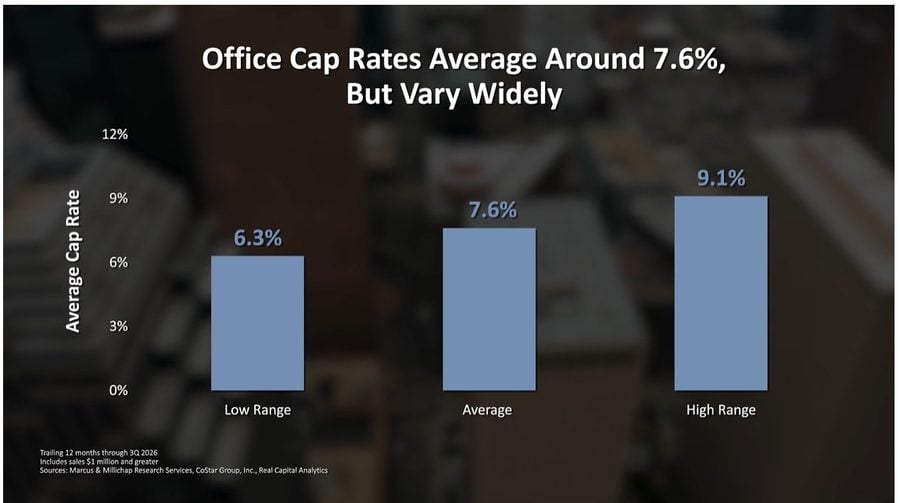
Apartment cap rates also showed a wide range:
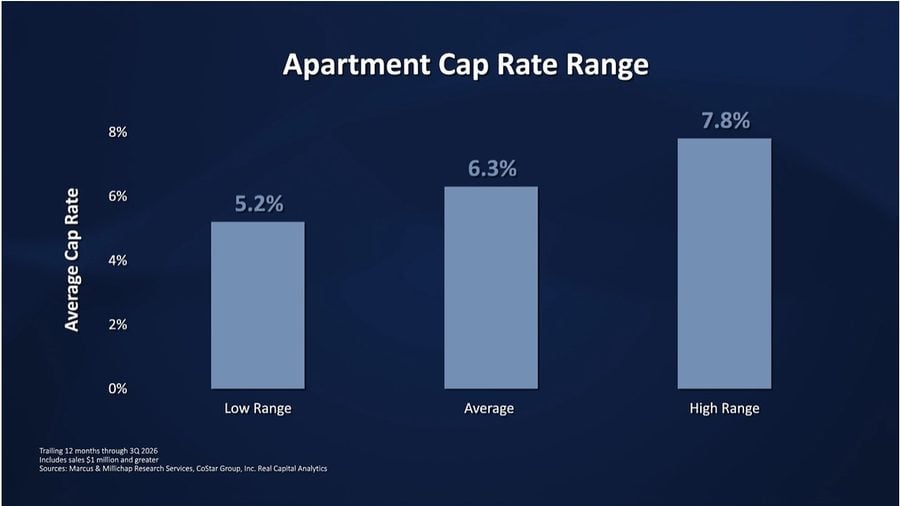
Chang said that many investors will push higher in the coming months, providing opportunities for investors. In addition, “motivated sellers are already reevaluating their pricing, creating unique investment opportunities,” he added.
Overall, the national economic and investment headwinds are real. But they can vary when you get down to the market and property level.
“At some point, the headwinds will abate,” Chang commented. “As that happens, core commercial real estate drivers like demographics, slowing construction, and pent-up demand will reassert.”
Photo: Who is Denny/Shutterstock
Other News

Roxborough Makes Second NorCal Apartment Buy Through Latest Fund
The Roxborough Group, LLC has acquired Bidwell Park, a 246-unit apartment community in Fremont, for $109.4 million. The 95% occupied property at 39800 Fremont Blvd. represents Roxborough’s second multifamily acquisition in Northern California within Roxborough Fund III, L.P., a $518-million discretionary fund focused on opportunistic and value-add investments. “The acquisition of Bidwell Park aligns with...
Learn more
University of Idaho Opens 451-Bed Student Housing Property
Gilbane and Rocky Mountain Companies, along with University of Idaho, celebrated the ribbon cutting of Vandal Village, a graduate and family housing complex on U of I’s Moscow campus. Located at 1010 Deakin Ave, the 200,000-square-foot complex encompasses 240 units, offering two- to four-bedroom plans. Designed to meet a range of housing needs, the development...
Learn more
LIHI Opens 90-Unit Tiny House Village in South Park
The Low Income Housing Institute (LIHI) has opened a 90-unit tiny house village in Seattle’s South Park neighborhood. Cloverleaf Tiny House Village at 9128 10th Ave. S. is LIHI’s largest village and will operate as a 24-hour shelter, reported the Puget Sound Business Journal. The Seattle-based nonprofit developed the project in partnership with New Direction...
Learn more
Brokers
View All-
Remax Real Estate Professionals
Re/Max Real Estate Professionals
-
Jared Ennis
Central CA Commercial | California
-
Rick Recckio
Recckio Real Estate & Development
-
Greg Corbin
Northgate Real Estate Group
Lenders
View AllManagement
View All-
Essex Property Trust, Inc.
California
-
Josh A
California
-
Bob Tuteur
-
Andrew Schildcrout